Vimala Bathineni

.png)
University of Southern Denmark
Cohort 2026
Supervisor
Morten Birkved
FABA LOOP: Quantifying Denmark's Soy-Protein Displacement Potential with Faba Beans using Stress-Adjusted Yields and Expansion Constraints
FABA LOOP investigates whether Denmark can realistically expand domestic faba bean production to reduce dependence on imported soy-based protein. The project quantifies current protein flows, identifies viable opportunities for expansion, estimates stress-adjusted yields under climatic and agronomic constraints, and evaluates environmental impacts of alternative expansion scenarios within Danish plant-protein food systems.
Europe currently relies heavily on imported soy-based protein, which is linked to deforestation and significant environmental impacts outside the region. FABA LOOP addresses the need for more resilient and sustainable plant-protein food systems by assessing how locally adapted faba beans can strengthen domestic protein supply, improve climate resilience, and support Denmark’s climate and sustainability targets.
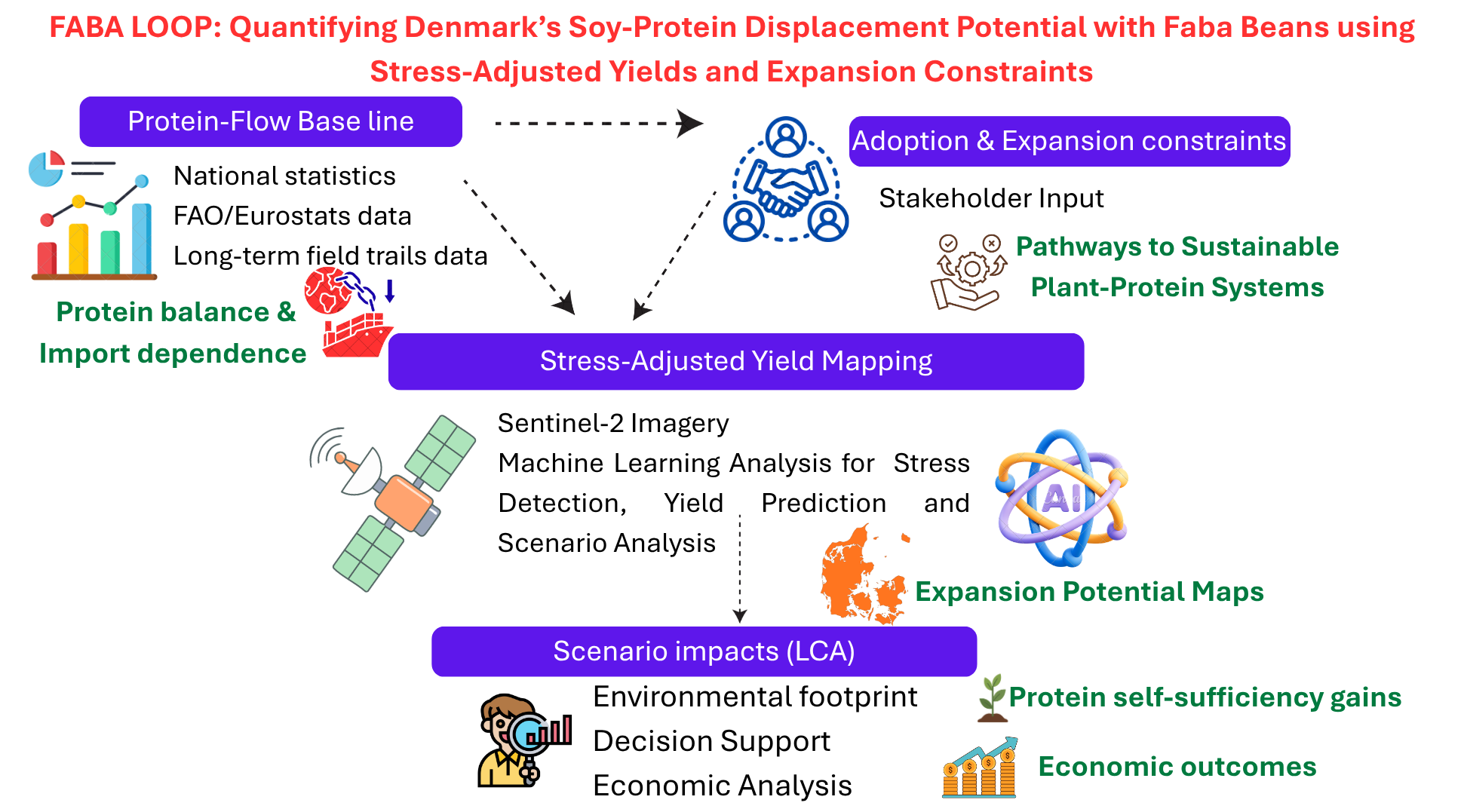
The project follows a four-step analytical framework. First, protein-flow accounting (Material Flow Analysis, MFA) maps Denmark’s current protein balance and soy import dependence.. Second, stakeholder-informed constraints from farmers, advisors, and agronomic datasets define realistic expansion pathways for faba beans. Third, Sentinel-2 satellite data combined with machine-learning methods produce stress-adjusted yield maps reflecting spatial and climatic variability. Finally, Life Cycle Assessment (LCA) evaluates scenario impacts for protein self-sufficiency, environmental performance, and broader sustainability outcomes in Danish plant-protein food systems.